Tuesday, February 28, 2023

New book by Carolyn Srygley Mooore

 From McLean's personal blog:


 We all have a past, Watson. Ghosts. They are the shadows that define our every sunny day.

// Sherlock Holmes;
Sir Arthur Conan Doyle

We have just completed a book called For All of My Beautiful Ghosts by awesome American poet Carolyn Srygley Moore. Carolyn actually writes real poems, which is enormously unusual nowadays, & we have done this book for her with a little better ink for the 177 numbered pages, since it also contains photos. This means that it would be inordinately expensive on bloody Amazon, pirates & scavengers that they are, so it will be on sale direct from Lulu. I shall add a link later, once we have seen the proof. 

EDIT: It printed fine &, after final edits, here it is at Lulu, For All of My Beautiful Ghosts. Because of the ink, it's more expensive, though to cut costs for the buyer we did at first not sell it from corporate scumbags Amazon we have now made it more expensive & moved it to distribution through Amazon. This is people are prepared to purchase it there & evidently prefer to spend more rather than less. The link is coming soon.

I shall almost certainly review it later, but I am currently reading about Kali Maa & finishing my book about Her as primal goddess in the Mahavidyas. Carolyn sets a bloody high bar for me with her wonderful book, but I want it to be my best ever.

Cover, featuring a collage by Carolyn herself, & my blurb follow:

Posthuman Poetry & Prose is delighted to release this book of poems by Carolyn Srygley Moore, a poet & artist resident in New York State.

These poems tell a life, & they are of ghosts in the sense that what one relates to is ghostly; it is the poematic impulse, which is to capture the past, to prove that it was real & that it still is, to produce "a photograph of the feast in mourning", as Derrida so aptly puts it, so there is always poem when the ghosts fade at sunset & earth is there, sustaining the futility that is world.


Tuesday, August 9, 2022

"Alien Songs" by Tanya Rakh & Ndotono Waweru

Delighted to announce the arrival of a book of duets by Tanya Rakh & Ndotono Waweru from Posthuman Poetry & Prose. The poems in Alien Songs, on sale here, & on sale here at Amazon, are of the posthuman diaspora that learns to survive beyond identity. Only the divergent returns. Only what is "alien", in the sense of estranged from humanist traditions, only what is Dionysian individuation - not the I, the self, & their identity - will be validated by the posthuman naissance that celebrates the chaos of the eternal return, where the subject is the Other, & alienated, in principle, from its "self" by the Kantian "Cogito for a dissolved Self: the Self of 'I think' includ[ing] in its essence a receptivity of intuition in relation to which I is already an other." (Deleuze). The chaosmos goddess creates is anarchic; identities are weak, they do not return. 

& poetry just is a nostalgia for presence, for simple self-identity, for all the substantial constructs, or so Derrida tells us. But poetry needs to be the inarticulate cry of intensity, the indeterminate, that which is not concealed behind a name or a face  but dances its passion in the flame & naked. Poetry needs to capture this, per impossibile - it might scream to that which throbs an instant in the meat & cannot be measured against anything. Otherwise things play real when you look at them & words grow into unreliable maps & forget what stars there are.

Though I publish others on an occasional basis, Tanya is basically the other half of posthuman poetry, & when I return to goddess it is my hope that she will take it over. It is a privilege to publish all of her previous & forthcoming work, & a delight to see how seamless this collaboration with Ndotono is.

Tanya & Ndotono wrote this intro

Alien Songs is a fully collaborative collection of duets in verse. These duets each stand alone as individual pieces, but also join together to create an amalgamated star atlas for a breathing and multitextured extraterrestrial world.

Each of our songs embodies an aspect of this world—some echo an element, others an organ, yet others a phenomena of nature—and there are many more totems to explore. All of these pieces, separately and combined, are calls to a connection beyond the confines of everyday space and time, the heavy matter of humanity.

While the maladjusted soul may not be able to easily drag its accompanying body off this planet for a spell, it can dissolve for a while between astral wind currents when the right words are sung. These duets are incantations, oracles, scribblings on the walls of the heart. By reading them, we hope all lonely Aliens can catch a few glimmers of their home stars.

Tanya Rakh and Ndotono Waweru

The book is absolutely amazing, & the cover is below, with thanks to the brilliant photographer Shaina Sterrett for letting us use her image. Here is Shaina's Instagram where she shares her art.

Here is a sample poem online at Spillwords at this link. Alien Songs is on sale at this link. it can also be found on Amazon at this link. Note that it is better for the writers if you buy direct from Lulu.

I am looking forward to the publication of Tanya Rakh's ghost fractals soon, goddess willing. There will also be a book of visual poetry, vispo, coming from Tanya too, this will be printed with quality paper & ink, everything you do to the moon. It will be awesome.

Sunday, July 24, 2022

New posthuman poetry manifesto

The manifesto about posthumanism that was posted previously in this blog now serves as the the introduction to my recent book of poems, everything essential. It builds upon the two previous manifestos about antinatalism & posthumanism that were included in the earlier books too much human & goddess says, Emma.

But I have now released a book of prose that isn't a novel. It's a book of theory about posthumanism, deep ecology, goddess, & poetics, There is quite a lot about posthumanism, about new materialism, about Heidegger & Derrida's discussion of poetics, about deep ecology, earth & world, & becomings-animal, & about Deleuze & temporality. Also, naturally, there is much about goddess & Tiamat, prior to the patriarchal deities of Babylon & later. All this in detail in the long version that is now on sale.

Here is the poetry book with the shortened introductory form of the manifesto - this is everything essential at Lulu. Then here is the Amazon UK link, & here is the link to Amazon USA.

Now this is the Lulu link for the full version, A new posthuman poetry manifesto, the proof looking great. The covers for both books are directly below too. The table of contents for the full manifesto follows.


Tuesday, July 19, 2022

Review of "everything essential" by Carolyn Srygley-Moore

 From David C. McLean's personal blog:

The book reviewed below, 205 pages of poems, & including a version of the new posthuman poetry manifesto, is on sale at this link. This link is to the book on Amazon UK, &, of course, this link is to Amazon USA. As always, i would prefer that you buy it from Lulu direct, but, if you hate trade unions or just need free shipping from Prime, you can use goddam Amazon.

Very grateful for this review of my (very soon) forthcoming everything essential by Carolyn Srygley-Moore. Delighted by this, I preserve her formatting as well as possible, given the exigencies of blogging. I would simply point out that I am not a philosopher, & am not sure what that would even mean (thus alluding, & without a trace of embarrassment, to Derrida), & I would add that memory, fairly obviously, is confabulation, telling stories. But still it's real, for, like all illusory constructs, time is perfectly real on its own terms. 

Review of everything essential
A book by David C. McLean.
By Carolyn Srygley-Moore, author of ‘miracles of the BloG: a series & Ode to Horatio and Other Saviors & other books, also with one forthcoming in the future from Posthuman Poetry & Prose.

Review of

everything essential

A book by David C. McLean.

“”

I am no philosopher.
However I’ve been a reader
And appreciator of David’s poetry for over a decade. (He is a writer of prose and a fine photographer as well.) We have also become friends. For a few years we lost contact. In those years David discovered & embraced
The Goddess.

When, via social media,
We first began exchanging writings
David professed a stern atheism; yet he
Arrived to my work (I then expressed
Myself as a Christian) without a derisive
Attitude; he was not contemptuous, and
Was able to read my work without derision.
That’s where I approach his new book.
With a blank slate attempted if not completely possible.

“”

McLean is a philosopher.
I arrive to this book with some cognizance
Of his prior work, and the tangentiality
That work has to this book.

“Ghosts.” That is
My echo. From my sense of his past work & the echo I cannot shake while reading.

“”

This book ,
Emma, & the poet, fuse into an amazement, a carnal revival occurring
On the head of a pin. There is no time.
Memory exists in the sensate, the beast,
A celebration that cannot be named
For language would corrupt that celebration.

“”

David, the person, tells me that we — humans, beings, sentient —; have no past.
Maybe all beings, in fact.

Yet memory, in these poems, is acknowledged. Remember that language
By no fault —: corrupts.

This is not the pop psychology of so called “false memory.” For memory in these
Poems is. Present carnal sacred.

“”

Is Emma (by the perspective of one who feels constrained by time as construct) a way of erasing
History per-say ( which David calls to my attention as “not mentioned” in the book)
Of radically traveling via Emma & goddess
Into the past, bringing back with him
The ghosts that riddled his early
Books with a kind of stasis however
Appreciative of the absurd //; returning
In Emma’s skirt pockets ghosts that
Have heartbeats without degeneration,
For time, and the past, are not
To be acknowledged. The Goddess is.

Without time; with the circularity, the
Regeneration exigent to the Goddess
Paradigm:
Emma exists past the perversion by
A language that McLean crafts
Flawlessly, intensely, even effortlessly.
As the reader I felt
Gratification that any
Person could experience love
With the transgressive intensity
Embodied in these poems.
The blaze, the beauty, and the
Resultant affirmation of what
Truth can be //: this is what I take
Away. & I am
Happy, especially for my friend.

“”

Foucault & Kafka, the incarceration &
The prisoner of the Penal Colony ::
Are crashed into, crushed as shell to
Grit. & we are freed. We are
Liberated by a manipulator of
Language// through
Language. We are left without
Corruption & the
Feeling Is marvelous.

Hence: even to those who find history
A weight, a presumptive cargo -/:
To whom trying to see time as not only irrelevant but nonexistent-:

What is remembering?

“”

What is sacred? Not time. Not the past.
But the dance on the head of a pin,
Beyond carnal, love, all consuming.

Emma is a means of liberation for
Those who devour these poems.
Where decay & death are acknowledged,
Even death —: endings are not.
All is infinite. A comforting, and uncomfortable, insinuation.

“Here we are memory” is a poem title
That gives me permission to read
These poems, & my personhood,
As a dialogue & confrontation & challenge
To /: my history my past. My ghosts
My memory. It is a profound
Permission coming from David
McLean, grab it. Writer. Philosopher.

Hold on.
Prepare yourself for a festival.
Dark & bright,

Carolyn Srygley-Moore


Monday, June 27, 2022

Lulu spotlight

Here is the Lulu spotlight for Posthuman Poetry & Prose. These are the books I have available, as well as books by Tanya Rakh & one by Linnet Phoenix, here at this link. Lulu charge postage, but this has become much more reasonable than it used to be.

All my extant books from Posthuman Poetry & Prose, & some other places earlier, are there. There are three novels, all fairly weird, basically anti. There are several chapbooks, & a considerable number of books of poetry. I have reduced the prices on the older ones, from other publishers than Posthuman Poetry, to conform to my current pattern of pricing, since I think the original prices were a little too high, & the listings on Amazon now reflect this change.

Themes in the books range from antinatalist & posthumanist manifestos, discussions of cPTSD & trauma, the goddess, the great mother, becomings_animal, the beast, sexuality, BDSM, love, libidinal economy, the incommensurability of intensity, diverse inequities, & psychiatric fascism. I am indebted to Deleuze & Guattari, Lyotard, Foucault, Mother Juliana of Norwich, Gertrude Stein, Derrida, & others for inspiration. Many of these books, the vast majority in fact, are written for my wonderful muse, Emma. After the older books, about half of the books belong to the thirteen volume series of "poems for Emma". Though the books written since my return to the UK, on the first of February, 2022, are not part of this series, technically speaking, Emma remains my "muse" & motivates my writing & is still present in almost all the poems.

As you may know, Amazon are sleazy & try to prevent unionization so they can carry on treating their workers like shit. They also, in my case at least, frequently list books from the wrong places, like Book depository, so you have to find the Amazon version yourself. As noted, it is way better if you buy them from here, unless relying on prime for shipping. In any case, Lulu are not quite as expensive for shipping as they used to be.


Friday, June 24, 2022

Autoerotic Elegies: Six samples from forthcoming "everything essential"

Autoerotic Elegies: Six samples from forthcoming "everything essential": Here are six samples from the forthcoming everything essential , due in about a month when I get a proof copy. The cover comes first. The ma...

Autoerotic Elegies: Jonathan Rossignol at LFLR Network

Autoerotic Elegies: Jonathan Rossignol at LFLR Network: Thanks to Jonathan Rossignol, American occult writer, for this awesome kickass podcast here on YouTube . The bit about me is chapter two of ...

Friday, May 27, 2022

Autoerotic Elegies: Samples from "skulls & dust"

Autoerotic Elegies: Samples from "skulls & dust": EDIT. This book is now approved for sale and is available  at this link . It will soon appear on Amazon. Here samples from fortchcoming skul...

Friday, April 22, 2022

Autoerotic Elegies: Amazon Author Page Update

Autoerotic Elegies: Amazon Author Page Update: Here is my Amazon.com Author Page, at this link . I have recently updated this so that all the books are available there now.  Here is the ...

Thursday, April 14, 2022

David C. McLean "goddess gives sun enough"

From blog of David C. McLean.

I have a new book of poems forthcoming soon, the first since moving to the UK, which will be available for sale once I have seen the proof. By me, David C. McLean, from Posthuman Poetry & Prose, goddess gives sun enough. Five samples & cover below. I shall update this post once I have seen the physical cover & made the book available for sale.

EDIT. This book is now on sale here at Lulu, Amazon too. This link is to UK Amazon. This link is to US amazon.com.

Blurb follows, then cover:

This book is the first written since McLean returned to England in 2022 , & follows a series of books of love poetry. As such, it shows an attempt to reorient to a life that is meaningful because of earth, nature, beast, & goddess, without any focus for the sexuality with which the flesh, as such, is instinct, & without any sense of social connection. The intensity differs thereby in its focus, though some themes are retained. These are poems about living on, & trusting in the goddess to give the fire & the words one needs to live & feel.


Sunday, March 6, 2022

Tuesday, March 1, 2022

Autoerotic Elegies: Art by Giselle Bolotin

Autoerotic Elegies: Art by Giselle Bolotin: Very pleased that Giselle Bolotin the artist was inspired to produce this awesome piece for me as response to the poem White Dwarf by Linnet...

Monday, December 20, 2021

Monday, December 13, 2021

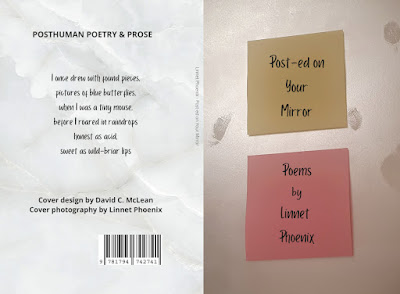
Review of "Post-ed on Your Mirror"

By David C. McLean & posted at his blog. Here is the blog of Linnet Phoenix.

This is a review of Post-ed on Your Mirror by Linnet Phoenix, edited & published by me for Posthuman Poetry & Prose, & on sale at this link. Editors should not review books as a general rule, perhaps, but I propose to make some observations about the book that are somewhat specialized.

Linnet Phoenix is a phenomenal poet. Poetry is very sickly nowadays. What currently passes for poetry is the modern form of what Heidegger calls Poesie. This was in Heidegger's day the traditionally "poetic" - rhyming verse, doggerel - though nowadays the epigones are all producing little imitations of Bukowski's crapulent ramblings, calling it "edgy". This trash is not the rebellion, of course; it is what must be rebelled against & subverted. Dichtung is the genuine article. Linnet Phoenix is the genuine article.

Dichtung is something totally different from standard poetry, it is the opening up of Dasein that prepares it to receive Being, the Otherness of Being as manifest in beings, it is the "poetizing" that precedes the event of any art & it is present particularly strongly in poetry itself. It not only precedes art, but perhaps any understanding of where Dasein is, where the "Da" itself is. This is what Linnet does. Poesie, on the other hand, is Gerede; empty talk, idle chatter, meaningless. A poem is true not by stating true propositions, most poems don't do that, & it is not their function so to do. A poem is true by giving an insight into the unconcealedness of Being in beings - aletheia is seen by Heidegger as being built from Lethe and the alpha privativum, and truth as thus being unforgetting, unhiddenness. Dichtung reveals truth, Poesie covers over the truth of Dichtung in its nonsensical verbiage. A poem should make the reader aware of the Earth.1

There is a religious imagery used in Linnet's poetry that is traditionally biblical, adopted from her traditionally Christian upbringing. I shall not go into this, but it is also a traditional strength. I have previously stated that she reminds me of Manley-Hopkins; the religious references connect to that, & so do the frequent hyphenated constructions that are perhaps less evident than usual in these short form poems. The following though is a clear reminder:

I am shipwrecked,
heart hull-holed
in smithereens

This I like to see as equivalent to the pre-Socratics in Heidegger. It is what we need to return to in order to carry on thinking. They still had access to the truth of Being, as Manley-Hopkins still had access to the world-making strength of words.

Thus again, I have returned to the the Heideggerian connection that I see in this poetry. The Earth/World (Erde/Welt) distinction is not one that Linnet deliberately focuses on, but it is very evident in passages like:

This old world howls
in the midday sun
as well as the frostbite moon,
but nobody listens

The old world that howls here is Earth, not world at all, & she is hidden; the average person, the average poetaster, knows nothing of this; it is only for those who are aware of the authentic poetic impulse that it is discernible. The reason the poetry that Linnet writes can be seen in terms drawn from Heidegger, or so I would assert, is that his description of what makes good Dichtung is pretty much correct, & Linnet is very good at this. It is possible to see Heidegger as saying that poetry is implicitly concerned with Being, whereas philosophy is explicitly concerned with it, or has been. But poiesis, so di Pippo argues,2 is rather the original means of access to Being that is broader than the distinction between poetry and philosophy & that makes both poetry & philosophy possible. After all, it is poetry that will assist in the task of thinking that comes after the end of philosophy.

We do not occasionally produce poetry in this sense, but dwell poetically. Poiesis is the event, Ereignis, the propriative event that generates the open clearing, the "Da" of Dasein, powered by an original experience of lack & instability & fragmentary self identity, the hiding away of earth & the turning away of goddess. It is there in poiesis that Being is put into beings, the sense of earth & divinity that is so sadly lacking from modern poetry, & particularly from the bogus wannabe poetry of the various flocks of epigones, chattering away like little rock doves, opinionated little pigeons cooing, the fluttering inanity of the "edgy".

Linnet, however, creates a sense of Being:

I thought my shadow left
but she is still here
waiting for us to awaken

the twin bears are restless
clawing at satellites
like leaping silver salmon

Poiesis is not a mirroring of a stable being, a presence, it generates presence. & this naturally brings us to Derrida. Maybe Derrida's depiction of poetry as a hedgehog trying to cross the Heideggerian Autobahn, a reminiscence, a “photograph of the feast in mourning”,3 is not as distant from a Heidegger understood as not believing so much in the function of poetry as revealing earth, unconcealing it,4 as a poetizing that generates world & an understanding of world & phusis.

I once drew with found pieces,
pictures of blue butterflies,
when I was a tiny mouse,
before I roared in raindrops
honest as acid,
sweet as wild-briar lips

The above passage is so beautiful, & it creates its world, it generates a world for us to exist, better than the world of societal ideology. It borrows from the Earth where Linnet stands firm to bless world with these tiny fragments of nature.

I do think that in Linnet's poetry we how Derrida's argument against the Heideggerian sense of poetry as disclosing unconcealed Being, saying instead that poetry is a nostalgia for a presence that never was, is part & parcel of Heidegger's original argument, the nostalgia is a result of lack, it generates Being, it gives access to Being. The obdurate life of the peasant working nature, expressed in the shoes painted by van Gogh, the struggle buried in the worn leather, the Earth where she worked, these are what Heidegger wants art to show.5

Linnet is, in my eyes, a major poet. She is one of those who generates a world. The Being she needs comes from her own productive work, & it is available for the reader in Post-ed on Your Mirror, since very few can do what Linnet does. She will show you how the Earth howls.


1 Heidegger, M. Poetry, Language, Thought (1971)

2 Alexander Ferrari Di Pippo. The Concept of Poiesis in Heidegger's An Introduction to Metaphysics. In: Thinking Fundamentals, IWM Junior Visiting Fellows Conferences, Vol. 9: Vienna 2000

3 Derrida, "Che cos'e la poesia" in A Derrida Reader: Between the Blinds, ed. Peggy Kamuf. Columbia University Press; see also "Istrice 2: Ich binn all hier,” in Points . . . : Interviews, 1974-1994, Derrida, Elisabeth Weber (ed) ISBN: 9780804724883 (Stanford Univ Pr., 1995)

4 Heidegger 1971

5 Op. cit.


Friday, December 10, 2021

Post-ed on Your Mirror, by Linnet Phoenix

We are delighted to announce the impending release of Post-ed on Your Mirror, by Linnet Phoenix. This book is based around a series of short form poems that Linnet previously posted on social media, &, in the case of a few of the poems, in some online & print publications.

I edited & produced this book for Linnet; she took all the photographs, & I designed the cover. This book is much more expensive to print than others that we have done; it is on better paper & in color, because I designed it to follow her idea of what it should look like, with image watermarks. For this reason, it is at first only going to be available on Lulu in order to keep the price down as far as possible.

Here at this link is Linnet's blog. & here below is the cover.


Work from Posthuman Poetry & Prose

Below we shall post the corresponding pinned post from David C. McLean's personal blog, but first list other works from Posthuman Poetry...