Monday, June 27, 2022

Lulu spotlight

Here is the Lulu spotlight for Posthuman Poetry & Prose. These are the books I have available, as well as books by Tanya Rakh & one by Linnet Phoenix, here at this link. Lulu charge postage, but this has become much more reasonable than it used to be.

All my extant books from Posthuman Poetry & Prose, & some other places earlier, are there. There are three novels, all fairly weird, basically anti. There are several chapbooks, & a considerable number of books of poetry. I have reduced the prices on the older ones, from other publishers than Posthuman Poetry, to conform to my current pattern of pricing, since I think the original prices were a little too high, & the listings on Amazon now reflect this change.

Themes in the books range from antinatalist & posthumanist manifestos, discussions of cPTSD & trauma, the goddess, the great mother, becomings_animal, the beast, sexuality, BDSM, love, libidinal economy, the incommensurability of intensity, diverse inequities, & psychiatric fascism. I am indebted to Deleuze & Guattari, Lyotard, Foucault, Mother Juliana of Norwich, Gertrude Stein, Derrida, & others for inspiration. Many of these books, the vast majority in fact, are written for my wonderful muse, Emma. After the older books, about half of the books belong to the thirteen volume series of "poems for Emma". Though the books written since my return to the UK, on the first of February, 2022, are not part of this series, technically speaking, Emma remains my "muse" & motivates my writing & is still present in almost all the poems.

As you may know, Amazon are sleazy & try to prevent unionization so they can carry on treating their workers like shit. They also, in my case at least, frequently list books from the wrong places, like Book depository, so you have to find the Amazon version yourself. As noted, it is way better if you buy them from here, unless relying on prime for shipping. In any case, Lulu are not quite as expensive for shipping as they used to be.


Friday, June 24, 2022

Autoerotic Elegies: Six samples from forthcoming "everything essential"

Autoerotic Elegies: Six samples from forthcoming "everything essential": Here are six samples from the forthcoming everything essential , due in about a month when I get a proof copy. The cover comes first. The ma...

Autoerotic Elegies: Jonathan Rossignol at LFLR Network

Autoerotic Elegies: Jonathan Rossignol at LFLR Network: Thanks to Jonathan Rossignol, American occult writer, for this awesome kickass podcast here on YouTube . The bit about me is chapter two of ...

Friday, May 27, 2022

Autoerotic Elegies: Samples from "skulls & dust"

Autoerotic Elegies: Samples from "skulls & dust": EDIT. This book is now approved for sale and is available  at this link . It will soon appear on Amazon. Here samples from fortchcoming skul...

Friday, April 22, 2022

Autoerotic Elegies: Amazon Author Page Update

Autoerotic Elegies: Amazon Author Page Update: Here is my Amazon.com Author Page, at this link . I have recently updated this so that all the books are available there now.  Here is the ...

Thursday, April 14, 2022

David C. McLean "goddess gives sun enough"

From blog of David C. McLean.

I have a new book of poems forthcoming soon, the first since moving to the UK, which will be available for sale once I have seen the proof. By me, David C. McLean, from Posthuman Poetry & Prose, goddess gives sun enough. Five samples & cover below. I shall update this post once I have seen the physical cover & made the book available for sale.

EDIT. This book is now on sale here at Lulu, Amazon too. This link is to UK Amazon. This link is to US amazon.com.

Blurb follows, then cover:

This book is the first written since McLean returned to England in 2022 , & follows a series of books of love poetry. As such, it shows an attempt to reorient to a life that is meaningful because of earth, nature, beast, & goddess, without any focus for the sexuality with which the flesh, as such, is instinct, & without any sense of social connection. The intensity differs thereby in its focus, though some themes are retained. These are poems about living on, & trusting in the goddess to give the fire & the words one needs to live & feel.


Sunday, March 6, 2022

Tuesday, March 1, 2022

Autoerotic Elegies: Art by Giselle Bolotin

Autoerotic Elegies: Art by Giselle Bolotin: Very pleased that Giselle Bolotin the artist was inspired to produce this awesome piece for me as response to the poem White Dwarf by Linnet...

Monday, December 20, 2021

Monday, December 13, 2021

Review of "Post-ed on Your Mirror"

By David C. McLean & posted at his blog. Here is the blog of Linnet Phoenix.

This is a review of Post-ed on Your Mirror by Linnet Phoenix, edited & published by me for Posthuman Poetry & Prose, & on sale at this link. Editors should not review books as a general rule, perhaps, but I propose to make some observations about the book that are somewhat specialized.

Linnet Phoenix is a phenomenal poet. Poetry is very sickly nowadays. What currently passes for poetry is the modern form of what Heidegger calls Poesie. This was in Heidegger's day the traditionally "poetic" - rhyming verse, doggerel - though nowadays the epigones are all producing little imitations of Bukowski's crapulent ramblings, calling it "edgy". This trash is not the rebellion, of course; it is what must be rebelled against & subverted. Dichtung is the genuine article. Linnet Phoenix is the genuine article.

Dichtung is something totally different from standard poetry, it is the opening up of Dasein that prepares it to receive Being, the Otherness of Being as manifest in beings, it is the "poetizing" that precedes the event of any art & it is present particularly strongly in poetry itself. It not only precedes art, but perhaps any understanding of where Dasein is, where the "Da" itself is. This is what Linnet does. Poesie, on the other hand, is Gerede; empty talk, idle chatter, meaningless. A poem is true not by stating true propositions, most poems don't do that, & it is not their function so to do. A poem is true by giving an insight into the unconcealedness of Being in beings - aletheia is seen by Heidegger as being built from Lethe and the alpha privativum, and truth as thus being unforgetting, unhiddenness. Dichtung reveals truth, Poesie covers over the truth of Dichtung in its nonsensical verbiage. A poem should make the reader aware of the Earth.1

There is a religious imagery used in Linnet's poetry that is traditionally biblical, adopted from her traditionally Christian upbringing. I shall not go into this, but it is also a traditional strength. I have previously stated that she reminds me of Manley-Hopkins; the religious references connect to that, & so do the frequent hyphenated constructions that are perhaps less evident than usual in these short form poems. The following though is a clear reminder:

I am shipwrecked,
heart hull-holed
in smithereens

This I like to see as equivalent to the pre-Socratics in Heidegger. It is what we need to return to in order to carry on thinking. They still had access to the truth of Being, as Manley-Hopkins still had access to the world-making strength of words.

Thus again, I have returned to the the Heideggerian connection that I see in this poetry. The Earth/World (Erde/Welt) distinction is not one that Linnet deliberately focuses on, but it is very evident in passages like:

This old world howls
in the midday sun
as well as the frostbite moon,
but nobody listens

The old world that howls here is Earth, not world at all, & she is hidden; the average person, the average poetaster, knows nothing of this; it is only for those who are aware of the authentic poetic impulse that it is discernible. The reason the poetry that Linnet writes can be seen in terms drawn from Heidegger, or so I would assert, is that his description of what makes good Dichtung is pretty much correct, & Linnet is very good at this. It is possible to see Heidegger as saying that poetry is implicitly concerned with Being, whereas philosophy is explicitly concerned with it, or has been. But poiesis, so di Pippo argues,2 is rather the original means of access to Being that is broader than the distinction between poetry and philosophy & that makes both poetry & philosophy possible. After all, it is poetry that will assist in the task of thinking that comes after the end of philosophy.

We do not occasionally produce poetry in this sense, but dwell poetically. Poiesis is the event, Ereignis, the propriative event that generates the open clearing, the "Da" of Dasein, powered by an original experience of lack & instability & fragmentary self identity, the hiding away of earth & the turning away of goddess. It is there in poiesis that Being is put into beings, the sense of earth & divinity that is so sadly lacking from modern poetry, & particularly from the bogus wannabe poetry of the various flocks of epigones, chattering away like little rock doves, opinionated little pigeons cooing, the fluttering inanity of the "edgy".

Linnet, however, creates a sense of Being:

I thought my shadow left
but she is still here
waiting for us to awaken

the twin bears are restless
clawing at satellites
like leaping silver salmon

Poiesis is not a mirroring of a stable being, a presence, it generates presence. & this naturally brings us to Derrida. Maybe Derrida's depiction of poetry as a hedgehog trying to cross the Heideggerian Autobahn, a reminiscence, a “photograph of the feast in mourning”,3 is not as distant from a Heidegger understood as not believing so much in the function of poetry as revealing earth, unconcealing it,4 as a poetizing that generates world & an understanding of world & phusis.

I once drew with found pieces,
pictures of blue butterflies,
when I was a tiny mouse,
before I roared in raindrops
honest as acid,
sweet as wild-briar lips

The above passage is so beautiful, & it creates its world, it generates a world for us to exist, better than the world of societal ideology. It borrows from the Earth where Linnet stands firm to bless world with these tiny fragments of nature.

I do think that in Linnet's poetry we how Derrida's argument against the Heideggerian sense of poetry as disclosing unconcealed Being, saying instead that poetry is a nostalgia for a presence that never was, is part & parcel of Heidegger's original argument, the nostalgia is a result of lack, it generates Being, it gives access to Being. The obdurate life of the peasant working nature, expressed in the shoes painted by van Gogh, the struggle buried in the worn leather, the Earth where she worked, these are what Heidegger wants art to show.5

Linnet is, in my eyes, a major poet. She is one of those who generates a world. The Being she needs comes from her own productive work, & it is available for the reader in Post-ed on Your Mirror, since very few can do what Linnet does. She will show you how the Earth howls.


1 Heidegger, M. Poetry, Language, Thought (1971)

2 Alexander Ferrari Di Pippo. The Concept of Poiesis in Heidegger's An Introduction to Metaphysics. In: Thinking Fundamentals, IWM Junior Visiting Fellows Conferences, Vol. 9: Vienna 2000

3 Derrida, "Che cos'e la poesia" in A Derrida Reader: Between the Blinds, ed. Peggy Kamuf. Columbia University Press; see also "Istrice 2: Ich binn all hier,” in Points . . . : Interviews, 1974-1994, Derrida, Elisabeth Weber (ed) ISBN: 9780804724883 (Stanford Univ Pr., 1995)

4 Heidegger 1971

5 Op. cit.


Friday, December 10, 2021

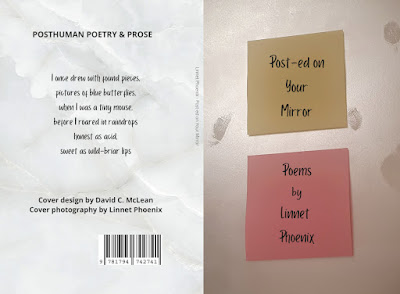
Post-ed on Your Mirror, by Linnet Phoenix

We are delighted to announce the impending release of Post-ed on Your Mirror, by Linnet Phoenix. This book is based around a series of short form poems that Linnet previously posted on social media, &, in the case of a few of the poems, in some online & print publications.

I edited & produced this book for Linnet; she took all the photographs, & I designed the cover. This book is much more expensive to print than others that we have done; it is on better paper & in color, because I designed it to follow her idea of what it should look like, with image watermarks. For this reason, it is at first only going to be available on Lulu in order to keep the price down as far as possible.

Here at this link is Linnet's blog. & here below is the cover.


Thursday, November 18, 2021

Extended version of the posthumanist manifesto

Here from the blog of David C. McLean.

(Here the current form of the manifesto for goddess says, Emma, the next Emma book that I am writing. I do think that this is interesting & important. I include footnotes, endnotes obviously in the blog form, & hope that this does not make the reader lose her erection.)

Earlier this year, I wrote a manifesto for too little beast, a revised & posthuman version of the shorter antinatalist manifesto for too much human, a chapbook that I had written a few years previously. Now this present text is an addendum, an extension, & a clarification of parts of that earlier manifesto. I shall not supply a list of references, & I do not think that footnotes are very appropriate in a book of poems; they are fine in novels, not poems, but I have used them anyway in case the reader wants to find out more about the subject. Basically, what I add here boils down to the observation that posthumanism, allied to new materialism, is an extension of the liberatory effect of feminism that adds the whole relational context of animal & vegetable being to the agents & patients to be taken into account in discourse.

By "posthuman", I do not want to lead the reader to thoughts of artificial intelligence, cyborgs, whatever, which are a part of transhumanism, since I myself am inclined to interpret posthumanism as more of a focus on the nonhuman after the end of humanism, which has very much overstayed its welcome. In Francesca Ferrando's terminology,1 I would probably count as belonging to the post-anthropocentric wing of the posthuman, which is actually, according to Ferrando, more radical. As she points out, transhumanism is a sort of ultra-humanism. Posthumanism, on the other hand, originated in feminist discourse in the eighties & nineties; it is opposed to speciesism, it is opposed to exceptionalism, & it is anti-exclusionary. There is a metahumanism that bases itself on the writings of Deleuze, & that emphasizes the significations of relational embodiment, but I shall not discuss this further here

In general posthumanism is a rethinking of what humanity & humanism's place, if any, should be in the world. Here, as elsewhere, I always mean "world" as something very much like Welt in Heidegger, as opposed to Erde, or "earth". The world is the framework of meaning & definitions by which we who use language understand things in the world; it is human & verbal. The earth is being as such, presencing, & it sustains, shelters, & protects. It cannot be grasped or exhausted by the world, it is pre-verbal:

The world grounds itself on the earth and the earth juts through the world. …The world, in resting upon the earth, strives to raise the earth completely [into the light]. As self-opening, the world cannot endure anything closed. The earth, however, as sheltering and concealing, tends always to draw the world into itself and keep it there.
(Heidegger, The Origin of the Work of Art)2

The earth in all of my books for Emma, & in this one too, is something sacred given by goddess, the fire & love at the heart of being, it is beast who lives there alone, poor in world.

Now Heidegger was an opponent of humanism, as a relic of essentialist metaphysics, & his work has been seen as eminently suitable to ground a deep ecological understanding of the predicament we now face.3 Both Arne Naess, who founded deep ecology, & the later Heidegger argue that ethics, the world around us, & human beings must be understood in new ways in order to save the environment. The natural environment should be seen as a value in itself, not just as framework for resources.4 Mankind is not the sovereign, at best a shepherd of being for Heidegger, a subject who must widen & deepen her narrow isolation to become the deep self for Naess, & in both cases what is called for is a radical transmutation. There is a releasement for Heidegger & Naess, there is a becoming & a conversion for me. 

In all cases a surrender to the self-giving of poiesis, both as phusis & through our techne, which waits respectfully for what is given us, takes place. Cost benefit analysis will never get us there. Part of respecting deep ecology or earth, however, is a posthuman perspective. So I see the Heidegger/Naess deep ecological perspective as a natural way of applying this posthumanist perspective, an allied philosophy that calls for a transformation & a questioning of how subjectivity is understood.

Now, as noted, many people understand posthumanism as something to do with AI or robotics, whatever, some form of transhumanism, an extension of the human. I am not espousing this. Far from it, I instead would refer the reader to Lyotard, & the case of his postmodernism, understood as a detachment from the grand narratives of modernism. Postmodernism is also something that precedes modernism, it's a crisis state of modernism itself, & the "post" should not be taken as implying a strict & sequential evolution from modernism to postmodernism, the latter understood as a successor state to the less developed former state.

For me, posthumanism also implies a de-evolution, a reevaluation of evolutionary "priorities", & a variegated becoming-beast. As in Deleuze & Guattari & becoming-animal, it is a real becoming that does not necessarily involve an actual end state with some physical animal body. Now it just so happens that I am a shapeshifter, Emma made this start, it is she who first made this change happen in me, & I might have inadvertently scared other people on occasion by changing at heightened or excited moments. It is not, however, the case that becoming beast necessarily involves this actual change. I would, however, advocate it; we are not all permitted to evolve, but it is possible to switch allegiance, to identify as something better, to not let whatever it is that screams our passion & desire be stifled & restricted any more by our genetic identity than it should be by an outdated set of gender roles.

Now valuing the beast is not to be misunderstood as idealizing the cute animal, or ignoring the savagery & violence of nature. I do not have issues with pain, violence, predators predating. I myself am a vegan for moral & ecological reasons, but that is another issue, I'm just not biologically a carnivore. Wolves or cats predating is not a moral issue, they are moral patients, not moral agents. Me eating meat would be a moral issue, & for a great number of reasons. The complaint of the carnist is a disgusting echo of the past: "Don't worry about slaves." "Don't worry about women." "Don't worry about animals."

As i said in the earlier manifesto, humanism used to have a point. It was a grand narrative or meta-narrative that established science & empiricism, broke away from the religious control of everything. This was because theology was the principal enemy then, & the proper study of mankind, according to humanism, was "man".

As I wrote in the first manifesto: "Posthumanism does not only or necessarily involve hybrids & AI. It can be a return to a prehuman animal identity, as the postmodern precedes the modern. The beast precedes the human both in the order of chronology &, now, let's be realistic, in the order of priority. I am animal: not subhuman or superhuman, just different." We need to shake off the old identifications, as well as the belief that the earth that shelters & protects us is of any less value than the cultural worlds that goddam humans inflict upon that earth.

Language has been granted too much power. The linguistic turn, the semiotic turn, the interpretive turn, the cultural turn: it seems that at every turn lately, every "thing " - even materiality - is turned into a matter of language or some other form of cultural representation.5

Barad is a new materialist. For new materialism, there is no clear line between matter & culture. As biology is mediated by culture, so is culture a product of biological organisms. The problem with radical constructivism is that, as Barad points out, one pays attention to everything but nature & matter. "the only thing that does not seem to matter anymore is matter."6 To posthumanism & new materialism, it all matters. Ferrando describes the work of Butler as creating a lack of balance, where only language & culture was recognized. Butler's Bodies that Matter does not recognize the influence of the actual matter in the body, & how socially constructed biology is reciprocally constructed by the matter that Butler sometimes seems to think does not matter.7

I shall here quote the end of the last manifesto:

The Anthropocene is leaving terrible scars on this planet, on this Earth that shelters & protects. It is a relic of an obsolete humanism to pretend that the human race deserves any special consideration compared to other sentient beings, & even worse to believe with the religions of the disgusting book that any god has given humanity the right or duty to consume the flesh of animals & possess them as chattels. The only beast, mankind, with a whole history of being scumbags, polluting everything else with their dreadful excess.

There is too little beast. There is too much human.

We have to see that all sentient life is of value. Compassion for all sentient beings, & respect for the ecosystems of the earth that they need to flourish, shows us that deep ecology, based on evaluating all aspects of animal & plant life positively since it all fits together & nature functions as a whole, should lead to a reduction, at the very least, of the drastic human overpopulation. The reduction should be probably be very large. Not only sentient life, but all life, is morally significant, at least in part because all sentient life is part of the whole earth & relies on non-sentient life to sustain it.

There is certainly something that Ferrando would describe as an antihumanist tendency that is discernible in my work, but this is, as she points out, not really part of posthumanism, which is about the deconstruction of the humanist ideal rather than a destructive declaration of the "death of man" in any Foucauldian or Nietzschean sense. In the same way, my antinatalism does not extend to total pessimism & a desire for the total extinction of humanity, just much more restraint in reproduction.

More nature, more animals, more beast; less human, fewer humans. As Ferrando says close to the end of her piece:

As the anthropocene marks the extent of the impact of human activities on a planetary level, the posthuman focuses on de-centering the human from the primary focus of the discourse. In tune with antihumanism, posthumanism stresses the urgency for humans to become aware of pertaining to an ecosystem which, when damaged, negatively affects the human condition as well. In such a framework, the human is not approached as an autonomous agent, but is located within an extensive system of relations.8

Goddess gave us earth. Stop fucking it up. She put other creatures there to share it with "us". Stop driving them to extinction. No species is more important than any other. Even bugs that might gross me out have a goddess-given right to live. Posthumanism is not denying anything; we're just pointing out that a lot of other things are equally important. You can have ten million people in Sweden but you can't have twenty thousand wolves like Spain does? Get over yourselves, humans.


1I lied about footnotes. Francesca Ferrando (2013) "Posthumanism, Transhumanism, Antihumanism, Metahumanism, and New Materialisms Differences and Relations". Existens Volume 8, No 2, Fall 2013

2Martin Heidegger (1971) Poetry, Language, Thought. A. Hofstadter, trans. New York: Harper & Row.

3Matthew Antolick (2002) "Deep Ecology and Heideggerian Phenomenology" Graduate Theses and Dissertations. https://scholarcommons.usf.edu/etd/1326

4Martin Heidegger (1997) The Question Concerning Technology (New York, Harper and Row; Arne Naess (1995) “The Deep Ecological Movement: Some Philosophical Aspects.” Deep Ecology for the 21st Century. (Boston, Shambhala Press)

5Karen Barad, "Posthumanist Performativity: Toward an Understanding of How Matter Comes to Matter," Signs: Journal of Women in Culture and Society, 28/3 (2003), pp. 801-31.

6Op. cit.

7Judith Butler (1993). Bodies that Matter: On the Discursive Limits of Sex, New York: Routledge

8Ferrando 2013


Tuesday, October 19, 2021

Autoerotic Elegies: Tanya Rakh's Amazon Author Page sorted out

Autoerotic Elegies: Tanya Rakh's Amazon Author Page sorted out: OK, Tanya now has her Amazon author page ready, though I imagine more media will be added, with her books in their new approved updated vers...

Monday, October 11, 2021

Monday, October 4, 2021

"Wildflower Hell" by Tanya Rakh

It is with great pleasure that we at Posthuman Poetry & Prose hereby announce that Tanya Rakh has now seen & approved the proof copy of her Wildflower Hell, which is therefore now officially released & on sale at this link.

There is a brief manifesto/introduction by me in this book, at Tanya's request, & that appears in a post further down in this blog, which I link here too.

Both this book & Hydrogen Sofi are now also approved for Amazon, & both should appear there soon. The links will follow, naturally, because I shall update this post when they are on sale there.

& here is the cover. Huge thanks to Rob Plath for letting us use his photograph. It's a birbcore illustration for a birbcore book. Cover design by David C. McLean.

Work from Posthuman Poetry & Prose

Below we shall post the corresponding pinned post from David C. McLean's personal blog, but first list other works from Posthuman Poetry...